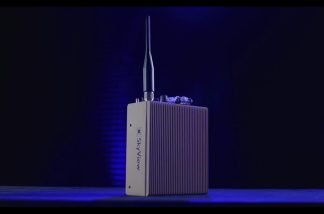
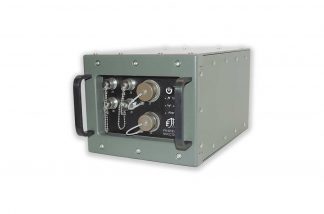
Blue Halo LOCUST TATS
Built on a modular, open-systems architecture and comprised of high technology readiness level (TRL) and commercial off-the-shelf (COTS) products and sensors, LOCUST Target Acquisition and Tracking System (TATS) is a high-performance acquisition, pointing, tracking, aimpoint designation and/or cueing capability comprised of electro-optical/infrared (EO/IR) and radio frequency (RF) sensor systems.
Featuring an advanced gimbaled EO tracking system designed for tracking various threat sets in cluttered or clear skies, the LOCUST TATS is made up of two main components: the fine tracking system (FTS) and the acquisition tracking system (ATS).
The ATS is equipped with multiple camera payload options that have a wide field of view, aiding in early target identification and tracking, along with a targeting laser designed to highlight targets. The FTS module includes a powerful telescope, a laser rangefinder, and additional camera payload options.
Human-Machine Interface (HMI)
Supports external network interfaces, provides the capability to accept external cueing messages, and distributes video, time, space, position information (TSPI), and tactical information to higher echelon target tracking as compared to traditional pan/tilt gimbal solutions.
RF Cueing Sensor Interface and Overlays
“Plug-and-Play” capability with a wide variety of sensor types and RF bands.
Multi-target IR Search and Track Modes
Automated tracking capabilities that enable agile switching between targets in high density threat environments
High Bandwidth Tracking for Threat Identification
State-of-the-art, high-definition video gives decision makers the highest fidelity data to evaluate threats in complex air defense environments.
High Resolution 3-D Target Location Reporting
Microradian-class track data transmitted to a wide variety of C2 networks. Increased system combat effectiveness.
Integration Support for C2 Networks
Low-latency interfacing with C2 networks to receive and provide target cues, with ability to transmit video, track, and provide situational awareness data to improve capabilities.