EPE announces the appointment of Tam Abbs as Strategic Pursuits Manager.
Tam joined EPE in February 2021. She brings over 17 years private and public sector experience and tertiary qualifications in Business Communication and Management (at Master level). Prior to joining EPE, Tam managed multidisciplinary client pursuit teams comprising executive and senior global operations personnel.
She is skilled at simplifying complexity to galvanise teams to pursue new business opportunities and/or deliver work packages for local, state and federal government agencies.
As an experienced and agile manager of internal and remote personnel, Tam can align resources and leverage global networks to support strategic pursuits in Defence, Transport, Water, Operations and Maintenance.
Versatile and transparent in her strategic approach, Tam has delivered solutions in process improvement, marketing and communication via alliance partnerships, in-house roles and sub-contractual arrangements. She is skilled in client management, workshop facilitation and delivery of complex communication and stakeholder requirements.
Veteran owned and proud Employer of Australian Veterans, EPE announces the appointment of Craig Jolly as Capture Manager, Land Domain.
Focused on optimising EPE’s solutions for ADF Land Projects that protect our military personnel from IED and CBRNe threats, Craig will lead on customer engagement and solutions architecture.
Craig is a motivated and well-respected military executive with over 35 years of proven experience in complex operational environments. He is renowned for developing innovative solutions to counter emerging threats; developing strategic and operational counter-threat capability and training; and the execution of training in support of operations.
Craig’s expertise is derived from key operational leadership, management and training appointments spanning 35 years in the Australian Army—most notably the development of specialist Chemical, Biological, Radiation, Nuclear and Explosive (CBRNE) defence capabilities as part of the Australian Defence Force (ADF). He also developed the Counter Improvised Explosive Device (CIED) assessment process and established the CBRNE cell in the Middle East Area of Operations as a member of the ADF CIED Task Force.
Apart from his ADF experience, Craig took long service leave in 2005; during which time he established the Mine Action Centre in Mostar, Bosnia and Herzegovina. In order to develop this new capability, he worked with US State Department sponsored contractors to establish a demining training school, trained the initial company of deminers and established and executed the first operational demining programme in Bosnia and Herzegovina.
The next-generation ResQ CQL handheld Raman analyzer used by law enforcement, border patrol, and the military for drug, explosive and hazardous materials detection has been recognized for its innovative design, marking a successful collaboration between Rigaku Analytical Devices and Juggernaut Design.
Rigaku Analytical Devices, the market leader in handheld 1064 nm Raman technology, proudly announces that its Rigaku ResQ CQL handheld Raman analyzer has won a prestigious 2020 GOOD DESIGN® Award. The GOOD DESIGN Awards Program organized by the Chicago Athenaeum recognizes the most innovative and cutting-edge industrial, product and graphic designs produced worldwide. The ResQ CQL handheld Raman analyzer was named a top product in the Industrial category.
In collaboration with Juggernaut Design out of Scottsdale, AZ, USA, Rigaku Analytical Devices engineered the ResQ CQL as a next-generation handheld 1064 nm Raman analyzer for advanced chemical threat and illegal drug analysis. Rigaku chose to work with the Juggernaut Design team due to their outstanding track record for producing truly rugged products for industrial applications.
EPE and 2 other Australian companies (Urban Circus, and Insitu Pacific Limited) are partnering with Downer Defence Systems (DDS) to develop and deliver an innovative route clearance capability. DDS has been awarded a $3 million contract through the Defence Innovation Hub as the Prime Systems Integrator for the project to develop a ‘Muskito’ prototype and then deliver a technology demonstration for Defence.
Contributing to the Australian Defence Force’s LAND 154 Phase 4 Project, the Australian industry partnership will develop an unmanned Counter Improvised Explosive Device (CIED) route clearance capability to detect threats above and below the ground’s surface; detect, discriminate and locate subsurface IEDs and flag them via a visual interface. EPE will supply innovation and integration support aligned to the provision of the HDT Hunter WOLF UGV, the Cobham Ground Penetrating Radar (GPR), and other technical systems.
EPE Managing Director, Warwick Penrose said “EPE is very pleased to partner with Downer and the Defence Innovation Hub on the Muskito program which aligns perfectly with our focus on the delivery of Force Protection solutions. The program will harness EPE’s CIED domain expertise, technology partners and innovative engineering to deliver a sovereign Australian capability that will protect ADF personnel deployed in non-permissive operational environments.”
Executive General Manager of Downer Defence Systems, Andrew Foster said ‘We are excited to work with the Commonwealth and our industry partners to develop the Muskito system. IEDs and other related threats have been the scourge of Australian and allied service personnel in their operations overseas in recent decades, and we are grateful to be given an opportunity to play a role in helping to mitigate that threat.’
‘This contract underscores the Government’s commitment to working with industry to create genuine and sustainable sovereign industrial capability,’ Foster said.
About EPE. Trusted to Protect
EPE provides CBRND, Counter IED and Force Protection solutions and support to Australian and New Zealand Defence Forces, Law Enforcement, and other government agencies. We are former Counter IED specialists with real world operational experience. We understand how Counter IED and CBRND equipment is used and more importantly, the demands placed on equipment and operators in the current ‘high-threat’ environments in which they may be deployed. We also understand the demands of the training and preparation required for operations. Our aim is to source the very best range of battle-proven equipment to help us deliver to our customers, a comprehensive and sustainable capability to meet evolving threats.
About DOWNER
Downer is the leading provider of integrated services in Australia and New Zealand and customers are at the heart of everything it does. It exists to create and sustain the modern environment and its promise is to work closely with its customers to help them succeed, using world-leading insights and solutions to design, build and sustain assets, infrastructure and facilities. For more information visit downergroup.com
For more information
Visit the website at: www.epequip.com or contact Narelle Hoffman, Marketing Manager +61 (07) 3308 9300 or email:
EPE ranks 17th in Australian Defence Magazine Top SME suppliers to Defence
Australian Defence Magazine (ADM) has released their 2020 rankings of the Top Contractors to the Australian Defence Force (ADF) and New Zealand Defence Force. The ADM ranking lists the top Contractors to the ADF and New Zealand Defence Forces (NZDF).
In the Top 20 ANZ SME ranking (which includes only Australian and New Zealand owned and operated suppliers) EPE is ranked 17th. EPE’s consistent position in these rankings since 2011, demonstrates our solid commitment to provide solutions to protect ADF and NZDF personnel. As an Australian veteran owned and managed small business, EPE’s strength has always been our unique ability to be agile and responsive to our customers’ requirements while delivering world-leading solutions, supported by domestic Through Life Support and specialist training.
EPE was Finalist for the Australian Prime Minister’s Veterans’ Employment Awards 2020, in the medium size company division.
The necessity in New Zealand for the Through Life Support (TLS) of essential Defence equipment to be delivered in-country has been particularly highlighted by COVID-19.
In this article, Editor Nicholas Dynon explore the TLS model that has been established and delivered in-country by EPE to ensure optimal Operational Availability (AØ) of essential equipment.
EOD10 is the world’s most trusted suit and is in-service with:
All four main branches of the United States military use Med-Eng Bomb Suits. The US Navy, Air Force, Marine Corps, Air National Guard and Air Force Reserves have all selected the EOD 10 generation Bomb Suit to protect their EOD teams. The US Army selected Med-Eng to build and deliver the ABS II Bomb Suit.
Over 50 countries have adopted the EOD 10
Four of the Five Eyes countries have purchased the EOD 10 (Australia, Canada, New Zealand and USA)
24 of the 30 NATO Member countries have bought the EOD 10
Med-Eng is the only company to have an NIJ certified bomb suit.
Med-Eng suits are also used at all levels of US Federal law enforcement with an explosive related response requirement.
Med-Eng bomb suits are used by every State, County, and Municipal Bomb Squad through the United States. An ever-growing number of these squads are using the EOD 10.
The Navy Autonomous Warrior 2020 (AW2020) Program aims to embrace Joint and Allied services, as well as Industry and Academia to promote the incorporation of Robotic, Autonomous Systems and Artificial Intelligence (RAS-Ai) into Navy planning.
EPE participated in Exercise Genesis, the first event in the program that demonstrated COTS robotic and autonomous systems as a proof of concept. The collaboration between industry ensured a heterogeneous robot and UAV fleet and a great outcome for all involved including Emesent, Boeing Insitu, CSIRO and Data 61, HDT and EPE, and FreeSpace.
Thousands of litres of methyl fentanyl point to ‘unprecedented’ production of opioids in so-called Golden Triangle area. Myanmar has made south-east Asia’s largest-ever seizure of synthetic drugs in raids that revealed “unprecedented” production of opioids in the area, the UN has said. Between February and April, authorities swooped on labs in the lawless Kutkai area of Shan state, seizing nearly 200m meth tablets, 500kg (1,100lbs) of crystal meth, 300kg of heroin, and 3,750 litres of methyl fentanyl.
The United Nations Office on Drugs and Crime (UNODC) described the haul as one of the largest and most successful counter-narcotics operations in the history of the region. “What has been unearthed through this operation is truly off the charts,” Jeremy Douglas, the UNODC south-east Asia and Pacific representative said in a statement. The production network could have been possible only with the backing of serious transnational criminal groups, he added. The raids unearthed “unprecedented” methyl fentanyl, the sign of a new trend of synthetic opioid production emerging “on a scale nobody anticipated”, said Douglas.
Fifty times stronger than heroin and up to 100 times more potent than morphine, fentanyl can be lethal from as little as two milligrams – the equivalent of a few grains of sand. It has fuelled an opioid crisis in the US that killed 32,000 people in 2018.
Myanmar is under pressure to stem the deluge of drugs from its border regions. Shan state is part of the “Golden Triangle” – a wedge of land cutting into Myanmar, Laos, China and Thailand and virtually untroubled by authorities despite the multi-billion dollar trade. Myanmar is the world’s second-biggest producer of heroin after Afghanistan, and is now widely thought to be the largest global source of meth, fuelled by the flood of precursor chemicals from China.
In response to the urgent requirement for ventilators in the UK due to the COVID-19 crisis, STI (Surface Technology International) based in Hook is building ventilators for the National Health Service (NHS). As an Advanced Electronics Contract Manufacturer STI has built specialist electronics for the global Defence industry for over 30 years.
STI and EPE have an ongoing partnership aimed at embedding sovereign capability through contract manufacturing in Australia of specialist electronics equipment for Defence and Law Enforcement customers in the region.’
To help keep the wheels of defence industry turning, we promised to fast-track invoice payments to Department of Defence suppliers. We’re delivering on that. Since 23 March, the Australian government has paid 78,000 invoices to a value of $4.8 billion. Of this, $3.3 billion has been paid early – and we know these early payments are flowing to Australian small businesses. We have made great progress to limit the effects of COVID-19 on small business in our defence industry. But we need to continue our support in backing small business so that they can continue to supply essential capability for our Defence Force. The Morrison government’s investment of over $200 billion in our defence capabilities is creating and supporting thousands of local Aussie jobs and has opened new and exciting opportunities for small business. Helping small businesses through this period and beyond is my top priority. That is why our government is continuing to inject much-needed cash in local Aussie businesses in our defence industry. We need small businesses to succeed in Australia so that they can continue to deliver the capability our men and women in uniform rely on each and every day.
Businesses like Brisbane-based EPE. Earlier this month, I had the pleasure of announcing that EPE had secured a $10 million contract with Leidos. They’re a small business that specialises in technologies to protect our soldiers from emerging threats, such as the risk of chemical and biological attacks. EPE will help Leidos deliver critical Defence capabilities in the area of chemical, biological, radiological and nuclear defence. In July last year, I visited EPE with my colleague, the federal member for Brisbane, Trevor Evans, to announce their $300,000 Defence Innovation Hub contract. To see their continued success since, including their partnership with Leidos, speaks to the quality of small Australian businesses that are contributing to essential Defence capability to keep Australians safe. Maximising opportunities for small businesses to compete as part of the Australian Industry Capability (AIC) Program will mean more Australian businesses, like EPE, can contribute to the delivery of defence capability and drive economic growth. The AIC Program requires tenderers to demonstrate that they have considered Australian industry as part of their tender response. Last year, the Morrison government released the Defence Policy for Industry Participation. This policy extended the AIC Program to all Defence materiel and non-materiel procurements above $4 million, as well as construction projects above $7.5 million. Previously, AIC requirements only applied to material procurements valued above $20 million.
This significant change is an example of how the government is backing Australian industry, especially small businesses. In times like these, we can be tempted to focus solely on business continuity, rather than pursuing innovation. But now more than ever, I want to commend innovative small businesses that are delivering and supporting enhanced ADF capability. For example, Darwin-based SPEE3D are piloting cutting-edge 3D printing technology in the Northern Territory. This local business is working with the Australian Army and the Royal Australian Navy to allow high-quality metal parts to be printed on demand in the field or at sea. This will significantly increase the ADF’s ability to access what it needs and when it needs it. Many Australian small businesses have smart solutions and innovative ideas that could contribute to our Defence capabilities. Opportunities exist for a broad range of small businesses – not just those who have traditionally thought of themselves as a defence industry business. Sea-to-Summit is a local WA business with one of the largest diversified suppliers of technical field equipment in the world. They have signed a standing offer deed to provide $30 million worth of field equipment to the Australian Army. This will include shelters, sleeping bags, hand tools, and personal protective equipment to support ADF personnel both in Australia and overseas. Under this deed, Sea-to-Summit is ensuring the ADF maintains a leading-edge in field equipment, making our personnel safer and more effective.
This is another example of how a small business, which would have typically sat outside the definition of ‘defence industry’, can and is having a marked impact on Defence capability. I also recently announced 11 Australian businesses had received a total of nearly $5 million as part of our Sovereign Industrial Capability Priorities grants program to help them grow our nation’s defence capability. Some of these included Queensland-based Frontline Manufacturing, which received $710,000 to continue its work on armoured fighting vehicles. Victoria-based Infinite Engineering received $1 million to increase the scale of manufacturing capacity and capability. And South Australia-based Simbiant received $278,475 to design and commission a software defined radar advanced signal processing facility.
Our government has pressed ahead with this much-needed injection of funds in small business because we recognise their fundamental importance to developing essential capability for the ADF. Our record $200 billion spend in Defence Force capability is not just buying us widgets, vehicles, ships and planes, it’s building up a sovereign capability in our small business community. Agility and capacity for innovation – hallmark qualities of Australian small businesses – are the attributes empowering business to successfully withstand the unprecedented impacts of COVID-19. I know, through my regular engagement with industry, that the vast majority of defence industry businesses are feeling supported by our government at this time. This was reflected in the recent Defence Connect COVID-19 Business Survey, which reported 79 per cent of business owners and 83 per cent of employees in the defence supply chain were satisfied with the government’s response to the crisis. We’re working harder than ever to ensure businesses have what they need to succeed. But I can have confidence in our defence industry because I’ve seen what they can do. Small businesses always have – and always will – play a vital role in building defence capability here in Australia. There are great opportunities on the road ahead. And I’m looking forward to helping them to get there.
Melissa Price is the federal member for Durack and Minister for Defence Industry.
Leidos Australia today announced it has selected Australian veteran-owned defence supplier, EPE, to support the Australian Department of Defence’s Land 2110 Phase 1B project. Under the subcontract, Leidos Australia and EPE will deliver critical defence capabilities in the area of Chemical, Biological, Radiological and Nuclear Defence (CBRND) to the Australian Department of Defence’s Capability Acquisition and Sustainment Group (CASG). The subcontract has a total value of $10 million.
As a subcontractor EPE will provision LCD 3.3 person worn chemical detectors and FILMARRAY® biological confirmatory systems to protect Australian Defence personnel from chemical and biological agents. The LCD 3.3 is a personal device for the detection and identification of Chemical Warfare Agents (CWAs) and Toxic Industrial Chemicals (TICs). FILMARRAY enables users to test for a comprehensive panel of respiratory viruses and biological agents in one easy-to-use test. Leidos Australia will support delivery and sustainment detectors and confirmatory systems for the life of the contract.
“EPE is proud to be a veteran-owned business with veteran employees who have served worldwide in specialist EOD, CIED and CBRN roles,” said Warwick Penrose, owner of EPE. “We are pleased to collaborate with Leidos and leverage our core business to provide specialist capabilities to our Australian Defence community.”
“Leidos has delivered complex logistics and CBRND capabilities globally for decades,” said Acting Leidos Australia Chief Executive, Paul Chase. “In creating our team for Land 2110, we have subcontracted with Australian SMEs, including EPE, to ensure we are delivering the best outcomes for Defence whilst supporting the growth and sustainment of the Australian industry.”
This is the fourth major subcontract awarded under the Land 2110 Phase 1B project, bringing the total amount awarded to more than $57 million.
FILMARRAY is a registered trademark of BioFire in the United States and/or other countries.
Joint Media Release The Hon Melissa Price MP, Minister for Defence Industry &
Federal Member for Brisbane, the Hon Trevor Evans MP.
The Morrison Government’s investment in a Brisbane small business has paid off, with EPE securing a $10 million contract with Leidos Australia to deliver chemical and biological defence capabilities to the Australian Defence Force.
Minister for Defence Industry, the Hon Melissa Price MP, said veteran-owned EPE received a $300,000 funding boost last year from the Morrison Government’s Defence Innovation Hub to help the business expand and develop its technologies.
“What this shows is that our record investment in Australia’s defence capability is helping businesses grow and succeed, all while building a strong and sustainable defence industry,” Minister Price said.
“EPE’s selection is indicative of the depth and capability of the defence industry in Queensland and Australia more broadly.”
Federal Member for Brisbane, the Hon Trevor Evans MP, said EPE specialises in technologies to protect personnel from emerging threats such as the risk of chemical and biological attacks.
“EPE will provide a detection capability that is critical to enabling the protection of Defence personnel in chemical and biological threat environments,” Mr Evans said.
“Minister Price and I visited EPE in June last year to announce their Defence Innovation Hub contract, so we’re thrilled to see how our Government’s support has given them the leverage to secure this significant contract.
“I congratulate this fantastic local Brisbane business on helping to ensure the ADF has the best capability to defend Australia’s national interests.”
Australian Veteran owned Defence SME announced as Finalist in Prime Minister’s Veterans’ Employment Award
EPE has been announced as a finalist in the annual Prime Minister’s Veterans’ Employment Awards for 2020 Employer of the Year – Medium sized business.
EPE is a 100% Australian veteran owned company delivering capability that protects our soldiers and first responders to the Australian and New Zealand Defence Forces and other government agencies.
EPE’s Director of Capability and former Commanding Officer of the Special Operations Engineer Regiment (SOER), Scott Corrigan, is proud of our Veteran status ‘EPE is founded on the specialist skills and expertise of Veterans, with 65% of our staff being former Defence Force members. As an employer we focus on supporting the transition to private sector by optimising the specialist skills developed in military service and underpinning this with new commercial skills not developed in Defence. ‘
The finalists, announced by Minister for Veterans and Defence Personnel Darren Chester, represent a range of industries and professions highlighting the contributions made by veterans in the civilian workforce and the businesses that support them.
The Awards ceremony will be held on 24 March in the Great Hall of Parliament House, Canberra.
EPE ranks 13th in Australian Defence Magazine Top SME suppliers to Defence
Australian Defence Magazine (ADM) has released their 2019 rankings of the Top Contractors to the Australian Defence Force (ADF) and New Zealand Defence Force. The ADM ranking lists the top Contractors to the ADF and New Zealand Defence Forces (NZDF).
In the Top 20 ANZ SME ranking (which includes only Australian and New Zealand owned and operated suppliers) EPE is ranked 13th. EPE’s consistent position in these rankings since 2011, demonstrates our solid commitment to provide solutions to protect ADF and NZDF personnel. As an Australian veteran owned and managed small business, EPE’s strength has always been our unique ability to be agile and responsive to our customers’ requirements while delivering world-leading solutions, supported by domestic Through Life Support and specialist training.
In 2019 we have invested more than ever in Research and Development as we successfully partnered with the ADF to deliver two further Projects through the Defence Innovation Hub. We were also awarded a New Zealand Minister of Defence Award for Excellence. Our New Zealand subsidiary, EPE. Trusted to Protect Ltd won the Award for Category 2: Provision of Product to Defence less than $15 million for delivery of the Counter Explosive Hazards (CEH) Project.
From left to right: Warwick Penrose Managing Director at EPE. The Hon Ron Mark, New Zealand Minister of Defence. Andy Cross, New Zealand Business Development Manager at EPE.
From left to right: Iain Swan, Warwick Penrose and Andy Cross from EPE. Paula Brasovan, NZ Ministry of Defence and LT COL Adam Modd, NZDF.
ANZ SME EPE wins New Zealand Minister of Defence Award for Excellence.
The 2019 Minister of Defence Awards for Excellence to Industry were presented on 25th November by The Honourable Ron Mark at Parliament House in Wellington, New Zealand. EPE. Trusted to Protect Ltd won the Award for Category 2: Provision of Product to Defence less than $15 million for delivery of the Counter Explosive Hazards (CEH) Project.
LT COL Adam Modd from the NZDF Capability Branch explained that the “CEH Project is to enable an expeditionary bomb disposal capability for both army and navy. Our personnel are required to go into harm’s way to protect people and property, and in doing so we’re trying to give them the best protection we can for them to achieve their mission. Working with a Prime Vendor such as EPE has allowed us to buy the right equipment in a timely manner and get it into service to meet the project timelines.’
The CEH Project Manager from the Ministry of Defence, Paula Brasovan commented, ”EPE was nominated because of their professionalism, they’ve gone the extra mile to be able to provide us with the information that we required”.
EPE New Zealand Business Development Manager, Andy Cross said ”The Ministry of Defence Project Team working with EPE as a Prime Vendor Industry Partner was able to deliver a capability that is scalable, interoperable, compatible with in-service equipment, with contemporary cutting edge technology, while heading off obsolescence all within a Rapid Procurement.”
While EPE Australia has supported NZDF for over ten years, this Project gave EPE the opportunity to establish infrastructure in New Zealand with a NZ company and office with a through life support workshop in the Wellington region, close to the Trentham Military Base. EPE New Zealand now employs 4 people with reach back to the EPE facility in Brisbane and our global network of Channel Partners.
The Awards were established by the New Zealand Defence Industry Advisory Council (NZDIAC) in 1998 to highlight and reward contributions made by industry to Defence. This year, Awards were presented in the following categories:
Category 1: Provision of a service to Defence less than $15 million
Category 2: Provision of product to Defence less than $15 million
Category 3: Provision of a product or service to Defence in excess of $15 million
Health and Safety Citation: Strongest overall demonstration of excellence in health and safety
Individual Special Award: For outstanding contribution from an individual from Industry to the relationship between Defence and Industry
Company Special Award: For outstanding contribution by a company who has demonstrated a significant contribution to Community and Nation through their relationship with Defence.
ABOUT EPE
EPE provides innovative solutions that protect our customers from an array of current and emerging threats. We are force protection specialists who apply our real-world operational experience to support and protect defence, law enforcement and emergency response personnel. We further leverage this experience to provide solutions to threats faced by industry and critical infrastructure.
Our solutions include: Deployable Infrastructure; Counter Improvised Explosive Device (C-IED); Counter Chemical, Biological, Radiological, Nuclear and Explosive (C-CBRNE); Remote Piloted Aerial Systems (RPAS) and Counter RPAS (C-RPAS); and unmanned systems. These capabilities are optimised through user-focused training combined with Through Life Support (TLS) delivered in operational theatres as well as domestically in Australia and New Zealand
For more information
Contact Narelle Hoffman, Marketing Manager +61 (07) 3308 9300 or email:
CASA investigating wayward drone during RAAF flyover_picture courtesy – NBN NEWS
CASA investigating wayward drone during RAAF flyover
The Civil Aviation Safety Authority is investigating a drone that was seen flying over the Newcastle 500 racetrack at the same time a RAAF Hornet was thrilling crowds in a low flying display over the race precinct.
The small drone was seen hovering at a height of around 100 metres before it dropped suddenly to the ground near the old railway workshops during the RAAF display on Saturday afternoon.
A strict no fly zone was enforced for the RAAF displays on the Saturday and Sunday of Supercars.
The Civil Aviation Safety Authority says “it is aware of the incident and is gathering information about it to determine if there has been a breach.”
It’s understood Supercars organisers and CASA had taken measures to anticipate the risk and were on the lookout for drones.
EPE has developed a complete suite of counter drone technology that enable organisations to detect, identify, monitor, or mitigate drones flying in controlled airspace (within legislative requirements) dictated by our customers’ needs and budgets.
New Australian partnership protecting public and private organisations against airborne threats to safety, security and privacy.DroneShield Ltd (ASX:DRO) (“DroneShield”), a global leader in drone detection and mitigation and EPE Trusted to Protect, Top 20 SME supplier to the Australian Defence Force, announce a Partnership.
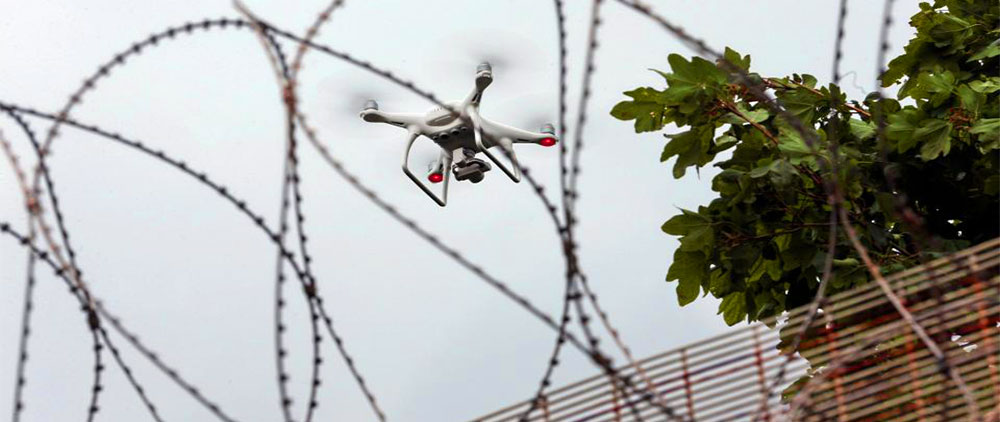
The emergence of small, lightweight, low cost drones offer many hobbyist and commercial applications, while enabling criminals, activists and others a new way to remotely deploy threats. Drones present one of the most challenging and dynamic emerging threats to defence forces on operations, to law enforcement, and to major events and critical infrastructure domestically. They can deliver contraband into prisons, carry out surveillance of military bases and assets, create major disturbances at high profile events, and deliver IEDs in combat zones.
DroneShield develops drone security solutions that protect people, organisations and critical infrastructure from unwanted intrusion by drones. Its leadership brings world-class expertise in engineering and physics, combined with deep experience in defence, intelligence, and aerospace. Oleg Vornik, DroneShield’s Chief Executive Officer said ‘EPE and DroneShield are both Australian owned companies with clear synergies. EPE has a solid record of delivering solutions to protect military, law enforcement and first responders in Australia and New Zealand for 30 years, providing world class equipment, training and integrated logistic support for the life of that equipment.’
Director of EPE, Warwick Penrose said ‘DroneShield has developed a complete suite of technologies that enable organisations to detect, identify, monitor, or mitigate drones flying in controlled airspace (within legislative requirements). EPE has counter drone technology already operating at a number of Australian sites, and the DroneShield offering gives an increased flexibility to provide discrete levels of protection dictated by our customers’ needs and budgets.
EPE’s strength is built on providing integrated solutions fully customised to meet our customers’ unique requirements whilst maintaining integrity in terms of quality, training and through life support. DroneShield is the only counter-drone company that has been accepted for membership of the Airports Council International (ACI) Europe. ACI Europe represents more than 500 airports in 45 European countries, including virtually every major European airport.
Great afternoon for EPE hosting the Capability Management Program. The Program is delivered by the Capability & Technology Management College (CTMC), training the next generation of capability technology managers for the ADF.
EPE supported the Legacy Defence Charity Ball with 12 EPE staff on a Corporate Table. Our team had a great night highlighted by some moving speeches of enduring support to bereaved ADF families.
Legacy is dedicated to caring for the families of veterans who have given their life, or health, as a result of their Defence Force service. This care extends to veterans who have served in war and on peacekeeping and humanitarian missions.
The Defence Charity Ball has been held annually since 2007, and all proceeds go towards funding the continuing work of Legacy.
This possible fentanyl exposure incident highlights need for large-area fentanyl neutralisation.
In a recent article by Eric Levenson and Mirna Alsharif on CNN, six staff members at the Chesire Correctional Institute were taken to local hospitals for possible exposure to fentanyl.
If fentanyl becomes aerosolised, it can be easily dispersed over an area by air circulated by fans or air conditioners. This can contaminate large surface areas or cause overdoses.
Correctional facilities are beginning to see these types of incidents occur frequently within cell blocks or common areas.
To reduce the risk of accidental overdose, personnel at jails and prisons should be trained to identify fentanyl and other synthetic opioids and response teams set up to quickly neutralise the threat before it spreads to larger areas.
EPE offers a wide range of decontamination kits that scale from an individual responder size to a large team or area decon kit that utilises an electrostatic sprayer. Details on the decon kits available can be found here.
EPE Innovation Engineer member of Robotics Innovation Workshop Team at NASA.
Australian owned small Defence company, EPE. Trusted to Protect is investing in Innovation and Prototyping including recently sending our Robotics Engineer, Robbie Wild to the US for a five-day Robotics Workshop jointly hosted by NASA and the CTTSO (Combating Terrorism Technical Support Office) at the NASA Johnson Space Center.
As a result of EPE’s focus and investment on developing solutions to evolving threats through innovative integration and prototyping, EPE has successfully delivered three projects through the Defence Innovation Hub over the last 18 months. The projects provide stand-off explosive and narcotic detection for Navy Boarding Parties; and Ground Penetrating Radar integrated onto in-service TALON robots for Route Clearance, and an enhanced version which physically marks and digitally maps the cleared routes to sub “cm” level accuracy.
EPE Director, Warwick Penrose said ‘We are investing in prototyping and integration to develop innovative ways to remove our soldiers and first responders from threats and building Australian skills and Australian Industry Capability in the process.’
The Workshop jointly hosted by CTTSO and the NASA is aimed to assist with CTTSO’s mission of expanding bomb response capabilities development. More specifically, the partnership addresses the CTTSO Improvised Device Defeat/ Explosives Countermeasures subgroup’s focus area of remote means, which seeks to develop or enhance technologies to remotely conduct neutralisation of unexploded ordnance (UXO), improvised explosives and their precursors, and hazard devices containing chemical, biological, or radiological materials.
The Workshop brought together bomb technicians and engineers to leverage their different perspectives while optimising their synergies to rapidly prototype robots for deployment on EOD operations at a substantially lower cost than commercially available. The bomb technicians represented Israeli Bomb Squads and US Army and Air Force, and Robbie Wild represented Australia amongst the engineers which mainly consisted of NASA Robotics engineers.
The long-term partnership between Smiths Detection (Australia) and EPE has been expanded, with EPE appointed as exclusive distributor for the Australian and New Zealand Military and First Responder/ Emergency Services markets earlier this year. EPE has assumed responsibility for marketing, sales and support for all Smiths Man Portable Detection solutions which include Chemical and Radiation Detection and Explosive and Narcotic Detection.
Jordan Thrupp, Managing Director, Australia and New Zealand for Smiths Detection said ‘EPE has a solid record of delivering specialised CBRND equipment to both the military and first responder communities, and providing world class equipment training and integrated logistic support for the life of that equipment. As a distributor, we have consistently been impressed by the EPE team’s relationship with Defence and First Responder customers and their commitment to providing supported capability that meets in-service requirements. EPE has proven to be a trusted partner, providing agile support to customers, rectifying issues promptly with a commitment to ethical business practices.’
‘As a global leader in detection technology, Smiths designs and manufactures world class detection technologies which protect our soldiers and emergency service personnel. EPE is positioned to provide expert advice reinforced by proactive and agile support. Our expert team has extensive real world CBRND experience gained in operational theatres representing military and police agencies in the UK, Australia, NZ and USA. The EPE Through Life Support (TLS) team is trained and accredited by Smiths enabling equipment training, software and firmware upgrades, repairs and second line support to be provided domestically in Australia and New Zealand’, said Warwick Penrose, Managing Director of EPE.
In addition to delivering Through-life Support to Australian Defence Force (ADF) equipment, EPE delivers capability and support to New Zealand Defence Force (NZDF). EPE has three Master Services Agreements (MSA) with the NZDF supporting EPE provided EOD and IEDD equipment. This includes the provision of Through-life Support to the NZDF diagnostics fleet delivering a high level of reliability to the New Zealand Defence Forces (NZDF) Chemical, Biological, Radiological, Nuclear (CBRN) and Explosive Ordnance Disposal (EOD) diagnostics and detection capability through scheduled maintenance activities. EPE’s technician based in NZ, provides minor maintenance, scheduled servicing, firmware upgrades, confidence testing and technical inspections on NZDF Chemical, Biological, Radiological and Nuclear (CBRN) and EOD capabilities.
EPE also has an Equipment Master Services Agreement in place with NZDF for the Through-life Support pf HDT Deployable Infrastructure systems. The intent of the contract over a 5 to 15 year period, is to deliver optimal levels of Through-life Support and operational availability, without adding complexity or cost to existing lines of support. The agreement is for all equipment, spares, in-service support, and purchasing of new systems across the NZDF Services. The contract has been negotiated by and will be managed by EPE’s New Zealand team.
ABOUT EPE.
EPE provides innovative solutions to protect Military and Emergency Response personnel from current and emerging threats. We are force protection specialists with real world operational experience. Our solutions include Deployable Infrastructure, Counter Drone, Unmanned Ground Systems, Counter IED (Improvised Explosive Devices, including Radio Controlled Devices), and Chemical, Biological, Radiological and Nuclear Defence (CBRND). EPE balances global reach with local innovation and is establishing advanced manufacturing capacity in Australia to deliver sovereign capability.
For more information
Contact Narelle Hoffman, Marketing and Communications +61 (07) 3308 9300 or email: or contact Andy Cross, New Zealand Territory Manager .
Joint Media Release: The Hon Melissa Price MP, Minister for Defence Industry and The Hon Trevor Evans MP, Member for Brisbane
A Brisbane company that specialises in developing technologies to protect military and emergency response personnel has won backing from the Australian Government.
Minister for Defence Industry, the Hon Melissa Price MP announced that firm EPE has secured a $300,000 Defence contract to help it grow its business.
The company specialises in technologies to protect personnel from emerging threats such as improvised explosive devices (IEDs), countering drones and the risk of chemical and biological attacks.
The Minister toured the company’s facility today with the Member for Brisbane, Trevor Evans MP.
“This contract is a demonstration of how the Australian Government’s $200 billion investment over ten years in Defence capabilities is helping small and medium sized businesses right across Australia,” Minister Price said.
“Our investment in Defence is much more than just spending on big companies. EPE is an Australian SME which is working to protect and save lives on the international stage.
“Small and medium sized firms are every bit a part of our defence industry as our major partners.
“This funding will help EPE to improve its radar technology used to identify and track IEDs.
“I congratulate EPE and thank them for their work in helping Defence to deliver innovative new solutions to important global issues.”
Trevor Evans MP said EPE was a fantastic example of how a local Australian business can be part of the enormous defence industries investment under this Government.
“It was terrific to return to EPE today to see how this Brisbane company is developing innovative defence solutions,” Mr Evans said.
“EPE is an outstanding example of Brisbane leading the way when it comes to new solutions in protective and defensive technologies, doing big things on the world stage.”
“This is just one of many local success stories we are seeing in small and medium sized businesses which are receiving support to grow thousands of local jobs in our economy.”
Minister Price said funding for the company was awarded through the Defence Innovation Hub’s Special Notice solicitation process as part of Army Innovation Day 2018.
“The Defence Innovation Hub is working with industry to invest around $640 million until 2025-26 in developing innovative technologies,” Minister Price said.
EPE was thrilled to host The Hon Marise Payne Minister for Foreign Affairs and Trade, Trevor Evans Member for Brisbane along with their teams Matt, Wade and Tony at our facility in Brisbane. Having supported Department of Foreign Affairs and Trade for over a decade, we truly appreciate the opportunity to give the Minister an overview of the capability we provide that keeps our government staff safe on deployment in hostile environments. The entire EPE team genuinely enjoyed the opportunity to showcase bomsbuits and drive robots with Marise and Trevor.
QinetiQ North America (QNA) today announced that it has won the competition for the U.S. Army’s Common Robotic System-Individual (CRS(I)) program. The seven-year Indefinite Delivery Indefinite Quantity (IDIQ) contract, valued up to $164,487,260, is for the delivery of small ground robots. It includes a Low Rate Initial Production (LRIP) phase worth approximately $20m over one-to-two years, followed by a series of annual production releases. QNA has been awarded a $4,051,837 initial order as part of the LRIP phase.
The CRS(I) robot is designed to be back-packable and is equipped with advanced sensors and mission modules for dismounted forces to enhance mission capabilities. CRS(I) features an interoperability profile (IOP) compatible open architecture to support a variety of payloads and missions to detect, identify, and counter hazards.
This significant win for small ground robots builds on QNA’s recent contract awards for the Route Clearance Interrogation System program (RCIS) and Phase II of the Common Robotic System-Heavy program (CRS-H).
“Providing robust, reliable, and exceptionally capable ground robots to support our armed services has been a driving passion at QNA for decades now,” said Jeff Yorsz, President of QinetiQ North America. “Our CRS(I) robot combines performance, intuitive control, and easy transport with a very competitive price point. This will redefine the market for next-generation back-packable robots.”
Warwick Penrose, Director of EPE took the opportunity to attend a working lunch with the Australian Defence Minister, The Hon. Christopher Pyne, New Zealand Defence Minister, The Hon. Ron Mark along with both of the Chief of Defence Forces and the NZ High Commissioner, to discuss current capability delivery and Through Life Support contracts awarded to EPE that are supporting both the Australian Defence Force (ADF) and New Zealand Defence Force (NZDF). EPE was one of five Australian businesses at the lunch that all provide capability to both country’s Defence Forces.
As a small 100% Australian owned business supporting both the ADF and NZDF, EPE was grateful for the ongoing encouragement and advice offered by both Ministers and Service Chiefs. A trusted provider of Counter IED, CBRN and many other niche capabilities to both Forces for over a decade, EPE’s support to NZDF has grown significantly in recent years. As a result, EPE are opening their first New Zealand office in early April, close to the Trentham Military Camp, delivering products and services across several projects. The current project include the Counter Explosive Hazards (CEH) project, a project that is delivering NZ Special Forces their deployable EOD / CBRN and Exploitation capability, as well as Master Service Agreements with NZDF for Deployable Infrastructure, Explosive Ordnance Disposal (EOD) and Chemical, Biological, Radiological and Nuclear Defence (CBRND) capabilities.
EPE will continue to focus on delivery of Force Protection solutions into both countries with an emphasis on technologies that help to take individuals out of the danger area.
Drones flying through Watch and Act zones of Esperance fires yesterday hindered efforts to battle out-of-control blazes and prevented up to 100,000 litres of water being dropped by aerial support.
A white and a black drone was sighted flying through the Howick Watch and Act area yesterday at about 4.20pm, seriously risking the safety of the eight aerial support air crafts and forcing them to land.
Incident control officer Danny Mosconi said the air crafts remained grounded for two to three hours and the delay had a “significant impact” on crews who were already under serious pressure to battle the fires.
“Once aerial support and water bombers leave the area … this then poses a risk of fires gaining intensity, which in this case it did,” he said.
“We’ve been working since that incident to contain those fires.”
Police have started an investigation after a commercial drone understood to be worth almost $500,000 was shot down in a rural part of the ACT.
An ACT Policing spokesman confirmed officers responded to the incident in Tennent about 2.15pm on Thursday, February 14.
In Canberra, drones are being trialled to deliver food, beverages and medicine to suburbs and also to check vegetation is not growing too close to power lines.
“Investigations into this matter remain ongoing,” he said.
It is understood Evoenergy was using the drone to carry out surveying work when it was shot down near Apollo Road, and that local landholders had not been notified of the surveying work.
The drone and the equipment it was fitted with are understood to be worth nearly $500,000.
Evoenergy declined to answer questions about the incident. A spokeswoman said inquiries about “any matters related to unlawful behaviour” should be directed to ACT Policing.
London airports purchase equipment in wake of incidents that caused around 1,000 flights to be grounded
The UK’s largest airports are set to spend millions of pounds on anti-drone equipment, the Guardian understands, as they seek to protect themselves from future attacks like that which grounded about 1,000 flights into and out of Gatwick airport during the Christmas period.
The country’s two busiest hubs – London’s Heathrow and Gatwick – have brought in their own military-grade anti-drone apparatus. The owners of both airports invested millions of pounds in the equipment after about 140,000 passengers were affected by the unprecedented disruption to Gatwick.
EPE is a proud partner of the Australian Army On the Job Trainee (OJT) Program. Our team of technicians supporting specialist Counter IED equipment for ADF offers OJTs access to unique skillsets and gives them hands on experience working in a Defence Industry facility on: FP-ECM, Robotics, Counter Drone Solutions and building specialist devices for Counter IED training.
The calibre of Army apprentices placed at EPE over the past 4 years has ensured this Program has been mutually beneficial by providing training to the next generation of Defence Electronic Technicians whilst providing efficiency and innovation benefits to the company. As a result of recent Master Services Agreements with the New Zealand Defence Force, the EPE Through Life Support team has expanded and we’ve recently employed one of our past talented young OJT’s upon medical discharge from ADF.
EPE is a 100% Australian owned company that demonstrates our commitment to the Defence community through:
Recognised Supporter of Veterans Employment – 65% of EPE employees are veterans
Recognised Supporter of Reservists Employment – 25% of employees are active reservists
Multiple donation to the Australian War Memorial Afghanistan Exhibit
A Queensland company which has installed counter-drone security at a critical infrastructure site with a restricted airspace in Australia says it has detected 400 drones in just six months.
EPE uses the US-developed MESMER drone technology, which instead of using jamming techniques exploits drone protocols to identify a drone’s unique identification number and take control of the device.
EPE provides a range of security services including countering IEDs (improvised explosive devices) and chemical weapons as well as drones. Its top customers include the Australian and New Zealand Defence Forces, DFAT, the Attorney-General’s Department, as well as Australian police and emergency services.
Keith Mollison, a former bomb disposal specialist with the Australian and British military, now with EPE, said they had installed the MESMER system in the first half of 2018, after the client, which he is prohibited from naming, reported numerous drone sightings overhead.
“They had in the low tens of drones sighted over a period of time,” he said.
But because drones were “very small” and “fast-moving,” making them “difficult to spot by the naked eye” the actual number was far greater, he said.
“Our system has been in operation for just over six months now and it has detected well over 400 individual drones in that time. It was a surprise to the client and to us just how many there were, so the order of magnitude of the problem is quite significant,” Mr Mollison said.
While the MESMER system can disable drones by either landing them or returning to sender, the law currently only allows for the drones to be detected and identified but not downed, unless special powers have been granted by state or federal governments for one-off events or designated areas.
EPE ranks 13th in Australian Defence Magazine Top SME suppliers to Defence
Australian Defence Magazine (ADM) has released their 2018 rankings of the Top Contractors to the Australian Defence Force (ADF). The ADM ranking lists the top Contractors to the ADF and New Zealand Defence Forces (NZDF).
In the Top SME ranking for 2018, EPE ranks 25th among Small to Medium Enterprises (SMEs). In the Top 20 ANZ SME ranking (which includes only Australian and New Zealand owned suppliers) EPE is ranked 13th. EPE’sconsistent position in these rankings since 2011, demonstrates our solid commitment to provide solutions to protect ADF and NZDF personnel. As an Australian veteran owned and managed small business, EPE’s strength has always been our unique ability to be agile and responsive to our customers’ requirements while delivering world-leading solutions, supported by Integrated Logistics Support and specialist training.
In the 2018 financial year we have invested more than ever in Research and Development as we have successfully partnered with the ADF to deliver two Projects through the Defence Innovation Hub and have been awarded a further 2 Projects which will be delivered over the next year.
In the fields of Grafenwoehr, Germany, service members from the U.S., the U.K. and other U.S. Department of Defense entities watched as several new unmanned aerial tools were explained and demonstrated during a multinational joint equipment training brief April 2, 2018.
Led by a group of civilians from the U.S. Army Tank Automotive Research, Development and Engineering Center, the training brief served as a precursor to a scheduled Robotic Complex Breach Concept demonstration later this week. That demonstration will see the use of new air and ground equipment for the first time by Soldiers.
The unmanned aerial capabilities on display included the Lethal Miniature Ariel Missile System, Puma, and Instant Eye, which provided Soldiers the ability to evaluate and detect hazards in the training area from a safe distance.
“The aviation assets are invaluable,” said Staff Sgt. Brian Logan, a Chemical, Biological, Radiological and Nuclear Specialist. “One of the aviation systems, the Instant Eye, can actually detect hazardous exposure such as chemical or biological threats. The best way to prevent a CBRN injury is avoidance, and that’s what these assets allow us to do, avoid unnecessary exposure.”
Another aerial asset, the Puma system, is a small unmanned aircraft that gives Soldiers the ability to reconnoiter an area, capture photos and other mission enhancing abilities, without placing individuals in harm’s way.
InstantEye Robotics is pleased to announce it has secured a contract with the Defense Logistics Agency (DLA) in support of PMA-263, the Navy and Marine Corps Small Tactical Unmanned Aircraft Systems (SUAS) Program Office, to field 32 InstantEye Mk-3 GEN5-D1 SUAS systems (64 aircraft).
This procurement is being executed in support of a United States Marine Corps urgent needs request for field user evaluation. The new InstantEye Mk-3 GEN5-D1 platform expands mission scope and provides additional Reconnaissance, Surveillance, and Target Acquisition capability to the individual Marine or Sailor.
“We are very excited to start fielding the first system in our new InstantEye Mk-3 line of products, which is designed to further strengthen the security of our SUAS products as well as expand the capabilities and features of our systems,” said Tom Vaneck, Vice President of InstantEye Robotics. “The Marines have been great supporters of the InstantEye systems, and we think the InstantEye Mk-3 GEN5 system will greatly complement their existing portfolio and enhance force protection while reducing operational risk.”
The InstantEye Mk-3 GEN5-D1 is the smallest (~250g) in the InstantEye family of combat-proven, high-performance, affordable systems. It is an encrypted, all-digital system with superb real-time video and still imagery. Due to its small size, it has low audible and visual signatures, enabling it to operate undetected in close proximity to targets of interest. The system requires only a single operator and goes from a stowed configuration to fully operational in approximately one minute. With an ability to operate in all weather and locations, it is an unmatched tactical enabler with operational effects.
InstantEye Robotics is a division of Physical Sciences Inc., both located in Andover Massachusetts. InstantEye Robotics is a global leader in tactical unmanned aircraft systems. When customers need a reliable, portfolio-manageable, multi-mission system, they choose InstantEye.
The New Zealand Defence Force (NZDF) has signed an Equipment Master Services Agreement (MSA) with EPE for HDT. The NZDF’s current HDT shelter systems include Network Enabled Army, C4ISR Common Command Post Operating Environment (CCPOE), Role Two Enhanced (R2E) Medical Infrastructure and in the pipeline is a Deployable Joint Inter-Agency Task Force (DJIATF) Headquarters. The intent of the contract is to deliver optimal levels of Through-life Support and operational availability, without adding complexity or cost to existing lines of support. The agreement is for all equipment, spares, in-service support, and purchasing of new systems across the NZDF Services.
EPE Managing Director, Warwick Penrose said “The Agreement enables the NZDF to optimise operational availability and save time and resources in the purchase of HDT systems, as they can buy them under the Agreement efficiently and cost-effectively. This is a logical step as EPE’s support to New Zealand has been steadily growing over the last 10 years with EPE delivering equipment, training and Through Life Support across the CBRNE and ECM capability area, and we are the Exclusive Representative of HDT Global in Australia and New Zealand. The contract has been negotiated by, and will be managed by EPE’s New Zealand team.’’
EPE has two further MSA contracts with the NZDF supporting EPE provided EOD and IEDD equipment as well as providing support to other government agencies.
Autonomous Warrior 2018 at HMAS Cresswell provides a forum to demonstrate the potential for autonomous systems to support future Defence operations. EPE has been at the forefront of delivering protective equipment and unmanned systems to ADF to keep our soldiers at a safe distance from explosive hazards for 2 decades. As unmanned and autonomous systems develop rapidly, we are providing innovative solutions for Protected Route Clearance and Neutralisation to protect our soldiers from IED’s. Our medium term plan is focused on enhancing our recent capabilities developed through the Defence Innovation Hub and further developing our Australian Industry Capability through advanced manufacturing of some of these capabilities.
At Autonomous Warrior 2018 (AW18), EPE demonstrated the Armtrac 20T Robot for conventional demining, Explosive Ordnance operations and Counter-IED operations. The platform is flexible and scalable and provides forces with improved mobility. The system is sufficiently robust and agile enough to move across country and provide a surrogate scout for dismounted foot patrols; in this role it would enhance situational awareness and stand-off detection of threats. However, in mechanised operations, it could equally be transported on a standard 3.5 tonne trailer and be prepared for operations within minutes of identifying a potential threat for survey, investigation or render safe.
EPE also displayed the MESMER™ Counter Drone solution at AW18. MESMER™ uses Protocol Manipulation to detect, identify and mitigate drones. Unlike other systems that employ kinetic effects or radio jamming, which can have indiscriminate secondary effects, MESMER™ is a low power system, operating below 1 watt and within ACMA regulatory constraints. It only affects targeted drones without impacting other nearby communications systems. The MESMER™ counter drone system is currently installed at a sensitive and confidential critical infrastructure site in Australia.
Minister for Defence Industry, Steven Ciobo attends Royal Australian Navy Testing of Stand Off Detection prototype
The Royal Australian Navy has been testing EPE’s Maritime Portable Raman Improvised Explosive Detector (PRIED) system in Darwin this week. This project, awarded under the Defence Innovation Hub to the value of approximately $1 million, involves EPE working with Navy to develop a portable dangerous substance and explosives detector suitable for maritime operations.
EPE Project Manager, David Rye onsite in Darwin said, ‘Testing the prototype with Navy this week, we have achieved all Test Performance Measures beyond expectation.’
The function of the unit is to provide stand-off detection of narcotics, explosives, homemade explosives (HME), chemical warfare agents, toxic industrial chemicals, toxic industrial materials and related chemical precursors. The PRIED is man portable and can rapidly scan from 10m-40m with the ability to scan in excess of 40m (depending on the material) and day/night conditions. It uses a “next generation” eye safe raman spectroscopy sensor that utilizes deep-ultraviolet (DUV) illumination without detonating explosive material.
Warwick Penrose, Managing Director of EPE, a small Australian business based in Brisbane, is proud to be working closely with Defence to develop this next generation force protection capability for those members of the Royal Australian Navy who engage in boarding operations.
“The PRIED project recognises EPE’s long term commitment and investment in building and developing sovereign Force Protection capabilities that help take Australian servicemen out of the danger zone. Our team delivers a broad spectrum of innovative Force Protection capabilities that are in service today with the ADF, NZDF as well as local and federal police and first responders” Warwick said.
This Defence Innovation Hub project funded by the Federal Government gives EPE the opportunity to further develop this technology which has been deployed for force protection on Land, and modify it to meet the unique requirements of maritime application both in Australia, New Zealand and the Asia Pacific region.
Portable Raman IED Detection Systems (PRIED) provides stand-off detection of Explosives, Narcotics and Chemicals and removes the operator from the threat area allowing them to detect from a distance. The video looks at the cutting edge work being achieved by DARPA (Defence Advanced Research Projects Agency) working with Alakai to reduce the size of the system from man-packable to handheld. EPE has been funded 950k by the Australian Defence Innovation Hub to deliver a Prototype for our Maritime boarding parties in support of our Navy’s Counter Narcotic program in the gulf. PRIED was designed primarily for employment in the land domain and has not been built with consideration for salt water ingress. The Maritime PRIED project will deliver a PRIED prototype that has been optimised for maritime operations with the intent of providing enhanced protection to RAN boarding parties. This project is scheduled for completion in Nov 2018.
From left to right: Warwick Penrose – Managing Director at EPE, Robi Sen – Chief Technology Officer at Department 13, Sam Keayes – VP Transport and Security at Thales Australia.
EPE, Thales Australia and Department 13 signed a Memorandum of Understanding at Land Forces today in Adelaide following successful rapid integration of MESMER™ Counter Drone capability into the Thales Bushmaster.
MOU with Thales Australia, EPE and D13 to develop and integrate a commercialised version of MESMER™operating through the Thales ICS.
Mobile prototype of MESMER™ integrated into a globally proven military platform, the Bushmaster.
Adelaide, South Australia – This morning at Land Forces EPE, Thales and Department 13 signed a Memorandum of Understanding (MOU) following successful integration of the MESMER™ Counter Drone solution into the Bushmaster. The MOU outlines the intent for this solution to provide an interim cyber capability for the vehicle platform.
Drones have become a persistent and pervasive threat to deployed members of the Australian Defence Force (ADF), with insurgents using cheap commercial drones to survey defensive positions, assess the disposition of troops as well as deliver munitions and IED’s with disturbing ease and accuracy. Troops deploying from Forward Operating Bases (FOBs) need the ability to deny enemies the use of Unmanned Aerial Systems (UAS) without impacting friendly radio frequencies (RF). This has prompted EPE, Department 13 and Thales to integrate the MESMER™ Counter UAS (C-UAS) capability into the Bushmaster as an innovative prototype being displayed at the Land Forces Conference in Adelaide.
The Thales Bushmaster is combat proven, offering high protection and mobility. It has been successfully deployed by three armies on operations in the Middle East, Africa and Pacific. On-going design enhancements, a wide range of user selectable mission equipment and mature through life support have ensured that Bushmaster continues to offer leading capability to meet emerging threats and evolving customer requirements. The Thales Integral Computing System (ICS) is an example of this, implementing a network-based architecture to centrally host all applications in the vehicle and enable the integration of new technologies to combat evolving threats.
Warwick Penrose, EPE Director said ‘The integration of the MESMER Counter Drone capability into the Bushmaster completed in 3 weeks demonstrates that EPE and Thales can successfully work together to meet tight deadlines. The success of this prototype further supports our short-term plans to establish an advanced manufacturing capacity in Australia to deliver sovereign capability.’
MESMER employs protocol manipulation techniques to manage a single or swarm of UAS. It detects and identifies drone signals using Radio Frequency (RF) protocol signatures. Protocol manipulation then enables MESMER to take advantage of weaknesses inherent in digital radio systems allowing safe mitigation of threats. This low power, surgical approach has several advantages over kinetic energy or jamming techniques, both of which can have collateral impacts on untargeted nearby assets and friendly RF systems. MESMER’s software defined architecture allows it to be constantly updated in response to evolutions in current UAS threats and emerging capabilities. This flexible software defined architecture also enables it to be seamlessly integrated into the Thales ICS.
The MESMER capability is on display at Land Forces at the EPE Stand 1N29 and on the Bushmaster at the Thales Stand 1F15.
ABOUT EPE.
EPE provides innovative solutions to protect Military and Emergency Response personnel from current and emerging threats. We are force protection specialists with real world operational experience. Our solutions include Counter Drone, Counter IED (Improvised Explosive Devices, including Radio Controlled Devices), and Chemical, Biological, Radiological and Nuclear Defence (CBRND). EPE balances global reach with local innovation and is establishing advanced manufacturing capacity in Australia to deliver sovereign capability.
ABOUT THALES AUSTRALIA
Thales in Australia is a trusted partner of the Australian Defence Force and is also present in commercial sectors ranging from air traffic management and ground transport systems to security systems and services. Employing around 3,600 people, Thales in Australia recorded revenues of more than A $1.2 billion in 2017 and export revenue of over A$1.6 billion in the past 10 years.
Thales Australia has a history of patient investment to build advanced in-country capability across manufacturing, critical systems and services. Close collaborative relationships with local customers, Australian SME suppliers and research institutions combined with technology transfer from our global business enables Thales to tailor high quality solutions for Australian and export markets.
For more information:
contact Narelle Hoffman, Marketing and Communications +61 (07) 3308 9300 or email:
Other Press Releases mentioning the new partnership between EPE, D13 and Thales: Defence Connect ItNews
Four high-security Queensland prisons went into lockdown on Sunday night after drones were illegally flown overhead.
Queensland Corrective Services Commissioner Peter Martin said the drone use over Brisbane Correctional Centre, Brisbane Women’s Correctional Centre, Wolston Correctional Centre and Arthur Gorrie Correctional Centre was “irresponsible”.
Queensland Police is investigating the illegal drone use.
The four prisons returned to normal on Monday morning after a search of each property to ensure no contraband had been dropped off.
“The safety and security of our prisoners and staff is of upmost importance, which was put at risk by this ill-conceived stunt,” Commissioner Martin said.
“Drones are a real threat when used to introduce contraband into our prison system or to aid in the escape of prisoners, which is why the Queensland government introduced legislation earlier this year to make such actions illegal.”
A trial at Woodford Correctional Centre was begun this month to detect drones, intercepting communications through radio waves to identify the drone’s source.
The trial will continue for four weeks to test its use across all Queensland prisons.
Drone laws prohibit the use of drones over restricted areas and over areas where emergency operations are under way, and require drones to only be flown at during the day and within line of sight of the operator.
Greenpeace activists say they have crashed a drone into a French nuclear site, posting footage of the flight on the groups Facebook page.
The group said the stunt was to highlight the lack of security around the facility, adding that “at no time was the drone intercepted or even worried about”. The drone, which was decked out to resemble a tiny Superman, slammed into the tower in Bugey, about 30 kilometres from Lyon, according to the video released Tuesday. The environmental activist group says the drone was harmless but showed the lack of security in nuclear installations in France, which is heavily dependent on atomic power.
“This action has once again demonstrated the extreme vulnerability of French nuclear installations, designed for the most part in the 1970s and unprepared for external attacks,” the post read.
France generates 75 per cent of its electricity from nuclear power in 19 nuclear plants operated by state-controlled EDF. EDF said that two drones had flown over the Bugey site, of which one had been intercepted by French police.
MESMER™ Counter UAS capability selected as finalist in ThunderDrone II. Following successful trials at both Phase 1 and 2, MESMER™ has been selected to participate in the final round Phase 3 which will be held at Nellis Air Force Base, Nevada, from the 18th-20th of June. EPE is partnered with Department 13 to distribute, integrate, install, train and support MESMER™ in Australia and New Zealand and is in planning stage for advanced assembly of MESMER™ from our base in Queensland.
The ThunderDrone trials were initiated by SOFWERX upon the request of the United States Special Operations Command (“USSOCOM”) and Strategic Capabilities Office to assess the Unmanned Aerial Systems industry and leading technology within this field.
ThunderDrone II saw more than 450 Unmanned Aerial Systems technologies submitted, with 95 Companies invited to move forward and present in Tampa in January 2018. MESMER™ was a top performer at this event and was one of 34 companies invited to the ThunderDrone II demonstrations, held at Fort Bragg in April 2018. D13 is one of the final 6 companies selected for the final phase of the event.
D13’s progression in ThunderDrone II is evidence of MESMER™s superior capabilities in Drone detection, identification and mitigation. Department 13 CEO, Jonathan Hunter, commented: “We are very excited to be selected as a finalist of ThunderDrone II to demonstrate MESMER™s superior capabilities and to network with Government and military officials. The D13 team have received overwhelming positive feedback from event organizers, USSOCOM representatives and +280 Government official attendees of both events. Trials and Demonstrations represent a key component of D13’s sales and marketing strategy, as these demonstration events of emerging technologies are the predominant method of assessment prior to procurement for Government agencies. MESMER™s progress to the final stage of ThunderDrone II has already delivered multiple sales leads and the D13 team continues to work to convert these opportunities to unit sales.”
from left Warwick Penrose; EPE, Captain Ben Jankalns, JCITTF; Robbie Wild, EPE; David Rye, EPE; Rohan Heisler, Cobham; Kevin Hernan, Defence Innovation Hub; Kevin Targett, Cobham
Talon in-service robot mounted with Amulet GPR in Proof of Concept
Kevin Hernan, Defence Innovation Hub; Captain Ben Jankalns, JCITTF; Robbie Wild, EPE; David Rye, EPE
Defence Innovation Hub Proof of Concept delivered by EPE
EPE has completed the first phase of the innovation project awarded under the Defence Innovation Hub. EPE worked with Defence to integrate a Ground Penetrating Radar (GPR) capability (Amulet) that can be deployed remotely using TALON, the current in-service medium sized Unmanned Ground Vehicle (UGV) and demonstrated a Proof of Concept (POC) to prove the integration could work.
As separate entities, the Amulet and the Talon are proven and known capabilities, the POC was therefore designed specifically around proving they could be integrated to achieve a remote standoff detection capability. The POC was highly successful and the logical progression is to now produce a prototype of this capability.
Warwick Penrose, Managing Director of EPE said “The GPR for UGV project recognises EPE’s long term commitment and investment in building and developing sovereign Force Protection capabilities that help take Australian servicemen out of the danger area. The commitment made by the Defence Innovation Hub to support Australian industry in concept development and prototyping, will allow EPE to accelerate the development and delivery of innovative capabilities that meet the specific needs of the ADF. In addition, the technologies developed for the ADF right here in Australia, have equal application with neighbouring countries as well as traditional coalition partners. This creates the potential to generate strong export opportunities, expand our ability to create new employment roles and offer long term job security.”
EPE awarded $1 million Contract under the Defence Innovation Hub fund.
The Minister for Defence Industry, Christopher Pyne has announced the second contract awarded to Zangold Pty Ltd (trading as EPE.Trusted to Protect) under the Defence Innovation Hub fund. This project funded to the value of $1 million involves EPE working with Navy to develop a portable capability to assist with the stand-off detection and identification of homemade explosives, chemical warfare agents, narcotics and gases during the conduct of Maritime Operations. Warwick Penrose, Director of EPE said ‘We’re proud to be working closely with Defence to develop this next generation force protection capability for those members of the Royal Australian Navy performing hazardous boarding operations. This innovation has the potential to deliver a new paradigm in boarding operations enabling stand-off detection prior to boarding.’
“The PRIED project recognises EPE’s long term commitment and investment in building and developing sovereign force protection capabilities that help take Australian servicemen out of the danger zone. Our team delivers a broad spectrum of innovative Force Protection capabilities that are in service today with the ADF, NZDF as well as local and federal police and first responders” Warwick said.
This Innovation Hub Project funded by the Federal government gives EPE the opportunity to further develop this technology which has been deployed for force protection on land operations and modify it to meet the unique requirements for a maritime application.
“For this Project, we are partnering with ALAKAI Defense Systems, the manufacturer of PRIED and EPE has also extended our relationships with local engineering and fabrication companies as part of our commitment to fostering an innovative local supply chain. EPE is working with Australian based manufacturers to provide a holistic Maritime capability.” Warwick Penrose said.
EPE employs 20 people, and is headquartered in Brisbane with offices in Canberra, Albury/Wodonga and NZ.
EPE ranks 10th in Top 20 Australian SME suppliers to Defence Australian Defence Magazine (ADM) has released their rankings of the Top Contractors to the Australian Defence Force. The ADM ranking lists the top Contractors to the Australian and New Zealand Defence Forces. In the Top 20 SME ranking for 2017, EPE is 17th among SMEs (Small to Medium Enterprises). In the Top 20 ANZ SME ranking (which includes only Australian and New Zealand owned suppliers) EPE is ranked 10th. Our consistently rising position in this ranking since 2011, demonstrates EPE’s solid commitment to providing solutions to the Australian and New Zealand Defence Forces that protect our soldiers. As an Australian owned and managed small business, our strength has always been our positioning to deliver world-leading solutions, supported by performance based contracting ILS and specialist training, while maintaining our unique ability to be agile and responsive to our customers requirements.
We thank ADM for their support of Australian businesses in the Defence sector.
Warwick Penrose, EPE with Innovation Minister Kate Jones and State Development Minister Cameron Dick
QLD Ministers with QLD Chief Entrepreneur Steve Baxter and EPE Director Warwick Penrose With Boeing and Prof Arun Sharma from QUT
Warwick Penrose, EPE with Innovation Minister Kate Jones and State Development Minister Cameron Dick
Warwick Penrose addressing the media at QLD Government Announcement
QLD Ministers with QLD Chief Entrepreneur Steve Baxter and EPE Director Warwick Penrose With Boeing and Prof Arun Sharma from QUT
The Queensland Government welcomed the Federal Government decision to back Queensland’s bid to host the Defence Cooperative Research Centre (CRC) for Trusted Autonomous Systems (TAS). A $50 million centre to develop drone and robotics technology for the Defence Force will be headquartered in Queensland. It will be a national facility that develops technology like drones and robotics for the Army, Navy and Air Force.
EPE Managing Director, Warwick Penrose joined Innovation Minister Kate Jones and State Development Minister Cameron Dick speaking at the Queensland Announcement at QUT welcoming the Federal Government decision to back Queensland’s bid to host the Centre. QUT’s Professor Arun Sharma and the State’s Chief Entrepreneur, Steve Baxter also addressed the media at the announcement.
Innovation Minister Kate Jones said the location of this Centre in Queensland was a vote of confidence in the state’s world-leading innovation and technology capability. “This centre will draw together industry, researchers and local businesses to work with Defence to develop new technologies for drones and other unmanned vehicles,” she said. “This will develop critical mass in key technologies like artificial intelligence, robotics, and autonomous vehicles and will position Queensland as a global leader in these areas.”
State Development Minister Cameron Dick said the Palaszczuk Government recognised that defence was a critical industry for the state, employing approximately 6,500 workers.
He said an important feature of the proposal would be to develop sites for testing, trials and evaluation of drones. “We will invest in test facilities, including large drone zones in regional Queensland — both aerial and marine —as part of the CRC.’’
Both Ministers recognised the capability that global companies like Boeing, and small companies like EPE and Nova Systems, contribute to Queensland’s leading technology in this area.
EPE Managing Director, Warwick Penrose said his ‘company is a family run business that creates autonomous systems to enable our soldiers to get in, do the job safely and get home again’.
Queensland will contribute a Brisbane-based headquarters for the CRC, world-class testing ranges, support research and technology projects, support industry to develop standards for autonomous systems and the development of platform technologies for unmanned aerial systems.
Information from : Minister for State Development, Manufacturing, Infrastructure and Planning, The Honourable Cameron Dick / Minister for Innovation and Tourism Industry Development and Minister for the Commonwealth Games, The Honourable Kate Jones
MINISTER for Corrections David Elliott has thanked Corrective Services officers who seized steroid capsules smuggled into Lithgow Correctional Centre with the apparent use of a drone.
It is the first time that CCTV has captured a drone that appears to be dumping contraband in a NSW prison.
A member of the public first alerted the prison to the presence of the drone around the centre on Monday evening.
“I thank the member of the public and staff for their prompt response and the recovery of this contraband,” Mr Elliott said.
Courtesy of The Sydney Morning Herald http://www.smh.com.au
Drones have been recognised as a very real threat to Australian cities, as the use of the technology by terrorist organisations increases.
Defence contractor EPE manager Keith Mollison, who had 25 years’ experience in the British Army including a stint as deputy director of intelligence, spoke at the annual Safe Cities conference about the threat of drones on Wednesday.
Drones can inadvertently cause significant hazards to public safety,” he said at the Brisbane conference.
“The spectrum of improper and illegal use of drones, even inadvertently, ranges from mischief to mayhem to protest, even acts of terror. They are used for many purposes – for recreation, for journalism or commerce and a lot of legal uses as well. Even drones used for legal purposes have the potential to cause significant disruption.”
Drone collides with commercial aeroplane in Canada.
A drone has collided with a commercial aircraft in Canada, the first such incident in the country, according to the Transport Ministry. As reported by BBC News, the drone struck one of the plane’s wings, while six passengers and two crew members were aboard.
The aircraft sustained only minor damage and was able to land safely, the Canadian transport minister said.
Earlier this year, Canada announced that it was making it illegal to fly recreational drones near airports.
The law prohibited airborne drones within 5.5km (3.5 miles) of an airport and restricted the height of a drone’s flight to 90 metres (300ft).
Those breaking the restrictions could face fines of up to 25,000 Canadian dollars ($20,000, £15,000).
The Skyjet flight was heading to Quebec City’s Jean Lesage International Airport when the drone hit it on 12 October.
In a statement, transport minister Marc Garneau said: “Although the vast majority of drone operators fly responsibly, it was our concern for incidents like this that prompted me to take action and issue interim safety measures restricting where recreational drones could be flown.
“I would like to remind drone operators that endangering the safety of an aircraft is extremely dangerous and a serious offence.”
According to a UK Airprox Board report, a drone passed directly over the wing of an aircraft approaching Gatwick Airport this summer.
The drone was “flown into conflict” with the Airbus 319, with a high risk of collision, read the report.





 The Sydney Morning Herald, 30 January 2019.